Article
A minor tragedy of the commons
Gideon Boie
01/2026, Public Space
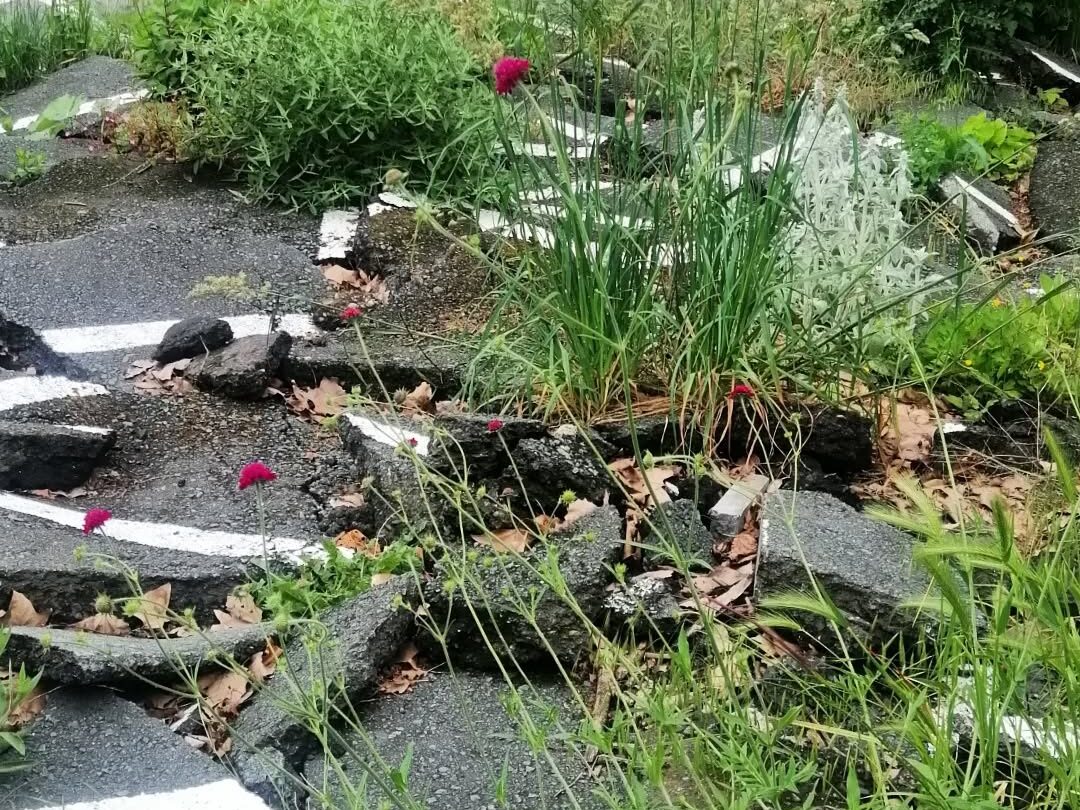
An empty plot on Bergensesteenweg in the Brussels municipality of Anderlecht gets transformed into a temporary neighbourhood square. In fact, it’s little more than a banal asphalt surface, safely fenced off with railings, located diagonally opposite the Bizet metro station. For years, this municipal property served as a parking and camper-van site, with the distant prospect of a redevelopment that never seemed to get off the ground. As part of a Sustainable Neighbourhood Contract (SNC), the plot was temporarily opened up under the name Bizet Bizar for a two-year period (2022–24). The car park became the peculiar residence of artists.
The triangular motif of painted white lines is a bold nod to the site’s former function as a car park. The asphalt was torn open here and there to make way for green rewilding, and the irregular chunks of asphalt were simply left lying around. Here and there, stray pieces of furniture have been secured with a few bolts – a row of seats from a bus stop, an umpire’s chair and so on. A shed built from salvaged materials brings to mind a saloon, albeit in a deconstructed style. A shipping container serves as useful storage space. A set of flags flutter in the wind. A circus booth blends right in too.
The cheerful chaos of Bizet Bizar symbolizes the future of the public space in Brussels. Beautiful squares and parks are one thing, but for decades, most of the public space in the metropolis has been taken over as parking spaces. This concerns both streets and residual spaces. There was a time when you could even park on the Grote Markt and right next to Central Station. Today, ‘King Car’ is being dragged off its thrown, albeit reluctantly. A cycle path on Bergensesteenweg is still a bit too much to ask, but a car park can be redeveloped, at least temporarily. And only half of it at that, as the municipal camper-van site was to remain untouched.
The transition from car park to neighbourhood square, under the supervision of Dear Pigs, was conceived as a slow process during which artists could temporarily reside on the square, more specifically Werkplaats Walter and MUS-E. Don’t go looking for works of art here and there. Bizet Bizar itself is a ‘relational artwork’ in the grand tradition of Nicolas Bourriaud, albeit set up outside the walls of the museum.[1] The parking site is the canvas, the local residents the paintbrushes. The artistic contribution consists in the presence of artists and the interaction they enter into with the place and the local residents.
The opening up of the municipal plot thus also fits in the disclosure of the urban commons.[2] The car park occupies a position between the private building blocks and the public space; geographer Edward W. Soja called this the ‘third space’ in the city.[3] Ownership doesn’t actually matter that much here; the car park may be in private hands or government-owned; what matters most is its communal use by local residents. Tearing open the asphalt produces a space in which local residents can forge new relationships through all kinds of creative activities.
And yet, use is not the most important element of Bizet Bizar as a new common. The suggestive emptiness of the space is central; what specifically happens there doesn’t really matter. Most activities were performative, and so there are not many traces of them to be found. The informal interventions and spontaneous activities on the new temporary square go beyond function. It is not about replacing one use – whether a car park or otherwise – with a more meaningful use; the issue is to preserve the ‘space of possibilities’.[4] An asphalt surface can serve as a car park, but just as well as the site of unexpected desires.
The fundamental emptiness of the commons is also its challenge, and the railings around Bizet Bizar are a silent witness to this. Under the label ‘use’, social interaction and cultural exchange soon become a fetish in the design of public space. Fun-filled activities by local residents undoubtedly provide a convenient alibi for opening up the location – defending a car park is not easy in the face of children having such fun. At the same time, use threatens to appear only in the light of public order and safety – there is no greater peril in the city today than an unused square.
The paradoxical result is that new public space in Brussels is invariably fenced off with metre-high railings. Take MolenWest and Park Ouest; former industrial zones at the West Station in Sint-Jans-Molenbeek are being discloded, but not without demarcating their use. The railings come with opening hours. The urban space is designed like a theatre – Rem Koolhaas described it as a principle of the generic city.[5] Urban life is animated by attractions, after which everyone is kindly requested to leave the theatre.
A second challenge of the commons is overcoming the temporary nature of the initiatives. Much of the new public space in Brussels is developed with a use-by date, its uncertain survival hanging over it like the sword of Damocles. Bizet Bizar, for example, was set up for a period of only two years. Ultimately, an important issue for the commons is their reproduction. After all, building a community is not something you do for the short term. Specific activities and interventions are without any obligation, not to say without any meaning, if they are not simultaneously seen in the light of the struggle for permanent recognition.
A successful practical example is Homebaked Cooperative Land Trust, developed by artist Jeanne Van Heeswijk to the 2012 Liverpool Biennial.[6] The artistic contribution consisted in breathing new life into a local bakery, located in a block of flats set for demolition opposite Anfield Stadium. The community’s struggle for the bakery stood for their struggle against the demolition of the neighbourhood. Baking bread was, of course, the daily artistic activity, but most of the energy went into setting up an organizational structure that would ensure the bakery’s survival once the arts festival ended. And so it came to pass. More than a decade later, the bakery is still running.
An example closer to home is ParckFarm, a neighbourhood park built on a former railway embankment in the Brussels municipality of Laken, initially intended as a festival site for the 2014 ParckDesign biennial.[7] From the outset, curator Petra Pferdmenges (Alive Architecture) was looking for ways to extend its six-month lifespan. Local residents were closely involved in the development of ParckFarm. A non-profit organization was established to run the Farmhouse. Artists were only paid the final instalment if their work could remain on-site after the biennial ended. After the festival, the competent minister for the environment had little choice but to recognize ParckFarm as a permanent public park.
In the end, Bizet Bizar didn’t become permanent. The parking site was closed in the autumn of 2024, once again in anticipation of impending construction work. The municipality promised to keep the activities running, albeit on a back burner. In the meantime, a new public contract was issued for the definitive construction of an ‘inclusive environment’ with a crèche, community centre and the like. Bizet Bizar failed to impose its own will on the local government – and perhaps that was never the ambition. Now we can only hope that the relational spirit of Bizet Bizar will live on in the plans for the future.
—
Bibliograhpic note: Gideon Boie, ‘A minor tragedy of the commons’, published in: Dearpigs (ed.), Asfalt, Billboard, Coiffeur: Notes on Bizet Bizar, (Mechelen: Public Space, 2026), pp. 107-111.
Footnotes
[1] Nicolas Bourriaud, Relational Aesthetics (1998; Dijon: Les Presses du réel, 2002).
[2] Lieven De Cauter, ‘Other spaces for the Anthropocene. Heterotopia and the dis-closure of the (un)common’ in: Heterotopia and Globalization in the 21st Century, Simon Ferdinand, Irina Souch and Daan Wesselman, eds. (London: Routledge, 2020), 19-33.
[3] Edward W. Soja, ‘The Trialectics of Spatiality’ in: Thirdspace: Journeys to Los Angeles and other Real-and-Imagined Places (Malden MA: Blackwell, 1996), 53-82.
[4] Gideon Boie, ‘Design Your Symtom: Expanding Architecture in the Context Mental Health Care’, in Unless Ever People, de vylder vinck taillieu and Gideon Boie, eds. (Antwerp: Flemish Architecture Institute, 2018), 186-223.
[5] Rem Koolhaas, ‘The Generic City’ in: Rem Koolhaas and Bruce Mau, S, M, L, XL (New York: The Monacelli Press, 1995), 1248-1264.
[6] Jeanne Van Heeswijk, ‘It Is a Fundamental Right to Have a Place to Live in Well: 2Up2Down / Homebaked’, Harvard Design Magazine 37, 2014.
[7] Petra Pferdmenges, Founding Alive Architecture: From Built Space to Lived Space (Mechelen: Public Space, 2018).
Tags: Brussels
Categories: Urban planning
Type: Article