News | Show all
07/05/2010

Kunstenaarsparticipatie valt in de prijzen

Het essay 'Kunstenaarsparticipatie... en hoe het leven en werk in Rotterdam verandert' kreeg een nominatie voor de Hans Baaij Essayprijs 2010.

18/04/2010

BAVO contributes to 'Power?... To which people?!'

The volume 'Power?... To which people?!' is edited by the artist Jonas Staal and published by Jap Sam Books, April 2010.

15/03/2010

Five Theses on the Neoliberal City

BAVO presented the 'Five Theses on the Neoliberal City' at the first Civic City Conference in Zürich.

03/02/2010

Doorstart kunstenaarsparticipatie in Rotterdam

Het Rotterdamse cultuurbeleid eist van de kunstsector een belangrijke bijdrage aan de sociale en economische versterking van de stad. BAVO stelde samen met CBK, TENT, Fonds BKVB en Dienst Kunst en Cultuur (Gemeente Rotterdam) een Actieprogramma op dat het rendement van kunst dringend moet opkrikken.


23/11/2009

De Afrikaanse stad als het sublieme object van de architect-planner?

Dat is de vraag die bleef hangen na het bezoek aan een recente conferentie over het Afrikaanse stadscentrum in Pretoria.

19/10/2009

New series of events on the borders of Europe in November and December

The events include lectures by Chantal Mouffe, Paul Scheffer and Markus Miessen as well as a film seminar with Ann-Sofi Siden and Maria Iorio & Raphael Cuomo.

14/10/2009

Steunactie architecten Lange Wapper

BAVO roept op tot solidariteit met de architecten van de Lange Wapper. De architecten zijn binnen de publiekprivate samenwerking gebonden aan een onwettige escalatieprocedure die hun bewegingsvrijheid en zeggenschap beperkt.

30/09/2009

Opheffen censuur in Architectuurnota Lange Wapper

Het Lange Wapper ontwerp van Laurent Ney en Paul Robbrecht is door de aannemer THV Noriant gereduceerd tot een zgn. 'extended idea'. BAVO vraagt de oorspronkelijke Architectuurnota openbaar te maken.

29/09/2009

Apartheidstad Pretoria

In de reeks 'Groeten uit...' schreef BAVO een stuk over de Zuidafrikaanse hoofdstad Pretoria en de manier waarop de stedelijke ontwikkeling er nog steeds getekend wordt door haar verleden als apartheidstad nummer 1.

16/09/2009

Orde van Architecten moet optreden binnen Oosterweeldossier

De inbreuken op de autonomie van de architect binnen de Oosterweelverbinding zijn een gevaarlijk precedent. BAVO vraagt de Orde van Architecten om een onderzoek in te stellen en zonodig disciplinair op te treden.

09/09/2009

Lange Wapper in overtreding met autonomie architectenberoep

Lees in De Architect hoe de Oosterweelverbinding ernstige schade toebrengt aan de unieke, bij Wet geregelde autonomie van de Vlaamse architectuur.

31/08/2009

Het Janssens Effect

In de Archined zomerreeks 'Groeten uit...' is een overzicht opgenomen van recente spraakmakende architectuurproducties in Antwerpen en hun bijdrage aan de sociale herovering van deze trotse havenstad.

24/06/2009

Architecturale kwaliteit Oosterweelverbinding in het geding

BAVO tekent bezwaar aan tegen het afleveren van een stedenbouwkundige vergunning voor de Oosterweelverbinding op basis van ernstige gebreken met betrekking tot de ruimtelijke en architecturale kwaliteit, de transparantie van het ontwerpproces, de interne kwaliteitscontrole op vlak van het ontwerp en de positie van de architect binnen de publiek-private samenwerking.

21/06/2009

De Janssens Werken mobiliseert jonge architecten

Een campagne informeert pas afgestuurde architecten over carrièrekansen in de Stad Antwerpen.


17/06/2009

Succesvolle lancering Stedelijk Protocol Kunstenaarsparticipatie

In een besloten Corrillos bijeenkomst in TENT. kreeg een selecte groep kunstenaars en vertegenwoordigers van kunstinstituties actief in Rotterdam de mogelijkheid om van gedachten te wisselen over het nut en voordeel van kunstenaarsparticiaptie voor de stad.

17/06/2009

Successful launch Urban Protocol for Artist Participation

In a closed Corrillos meeting in TENT, a select group of artists and representatives of art institutions active in Rotterdam were given the opportunity to discuss the use and advantages of artist participation for the city.

23/05/2009

Crisis in de autonome Vlaamse architectuur

Christophe van Gerrewey ontwaart een zorgwekkende hypnose in het Jaarboek Architectuur Vlaanderen 2006-2007 (editie 2008).

08/05/2009

De Janssens Werken in De Witte Raaf

Kijk uit naar komende editie van De Witte Raaf (#139) voor een neerslag van het debat tussen bOb van Reeth, Maarten Schmitt, Dirk Pültau en BAVO gemodereerd door Pieter Uyttenhove.

06/05/2009

Maastricht: Lieu de Passages?

BAVO moderates the workshop 'Between centers and peripheries' at the conference 'Maastricht: Lieu de Passages?' with Therese Kaufmann, Olivier Kramsch and Angela Melitopoulos.

OPPOSITIONAL ARCHITECTURE

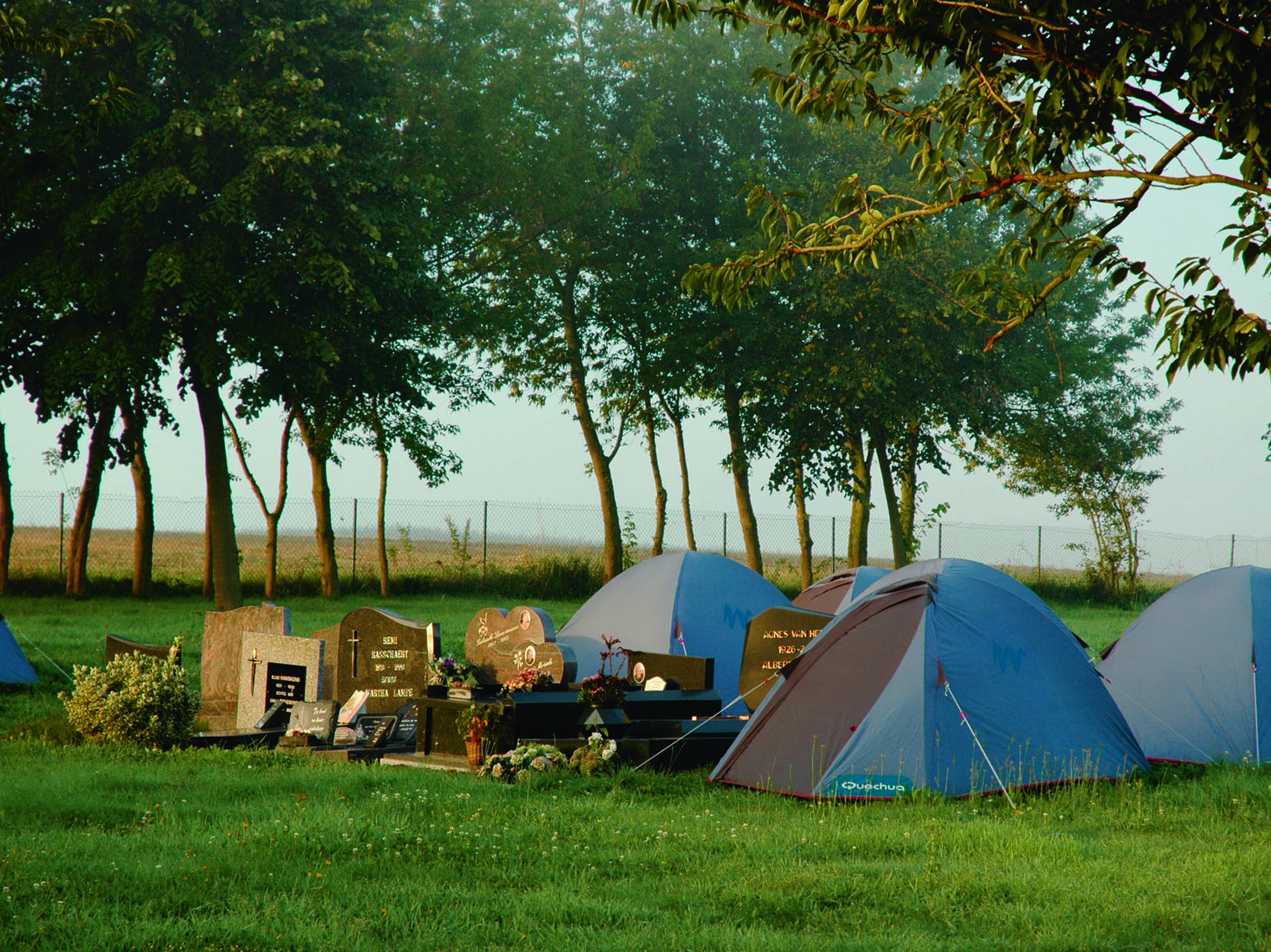
Intervention at Rozebeke Cemetery by Wim Cuyvers

Wim Cuyvers set up twenty tents overnight on the cemetery in Rozebeke, a subdistrict of Zwalm, within the pattern of the surrounding gravestones and at the same time showing absolute respect for the latest graves. This was part of ‘Art and Zwalm 2007’, and was an extremely serious response to the organisers’ assignment: to transcend the boundaries of the artistic and examine the relationships between art and the local social, economic and geographical situation. The tents provide shelter for the chance passer-by, in what Cuyvers calls perhaps the last public place in the urban landscape as we know it in Belgium. The cemetery is one of those rare places which are today still able to preserve themselves from the usual claims on space that originate from private interests. This is only logical, since, as the ‘place of loss’ – loss of time, power, means – there is nothing to be gained in a cemetery. This exceptional lack of economic pressure makes the cemetery the perfect place to enable a form of communication that is not driven by trends or interests, but rather questions existence itself.

Innocent as this intervention may seem, the local inhabitants turned out not to be particularly pleased with this sudden activity in the cemetery and even less with the virtual possibility of lodging there. No one listened to the arguments of a few passers-by that the extra tent space provided an excellent opportunity to reflect on the thin line between life and death, and in the future even to organise scouting activities there. This intervention was dismissed as a violation of the holy nature of the cemetery and as showing a distressing lack of respect for the repose of the dead. The national media eagerly picked up on this local upset and soon played it out in terms of cultural awareness. While the rural inhabitants were portrayed as having no sense of the human, poetic nature of the intervention, Cuyvers was shown up as the man who, in the name of art, would not submit to the will of the people. However, in all this it was deliberately forgotton that Cuyvers had emphasised several times that setting up tents in the cemetery may well have been done as part of an art biennale, but that apart from that it had nothing whatsoever to do with art. It was above all a reflection on the state of public space in Belgium, and Zwalm in particular: buried under road signs, speed ramps, route signs and boundary enclosures of all sorts – which not even an art route could avoid. It is this spatial choreography of the Zwalm area that Cuyvers saw as an enlargement of the ultimate capitalist vision of public space. It is a circulation space without conflict, risk or transgression in which one is only permitted to stop for the purposes of consumption and the entry into self-created, private detention centres.

It is as part of this sort of specific choreography that the tents in the cemetery create a space where there is the mental possibility of ‘being’ in Zwalm without being directly led by one or other instruction. Cuyvers thereby gives his own twist to the tent campaigns in French cities that give visual form to the right of the homeless to accommodation – from which he clearly drew his inspiration. The intervention in the cemetery makes it clear that today it is above all a question of demanding the right to withdraw from the daily pressure to consume, circulate and capsulise and claim the right to lodge in the public space with no obvious intention. In short, this intervention shows – perhaps despite Cuyvers – that the public space is only in theory an untouched, pure piece of land, and in practice soon becomes the object of obscure manipulation and calculation, and must rightly be won and defended.

References
The Flanders Architectural Yearbook 2006-2007 (edition 2008) is published by the Flemisch Architecture Institute (VAi): http://www.vai.be/nl/hetvai/vai_publi_detail.asp?id=289